
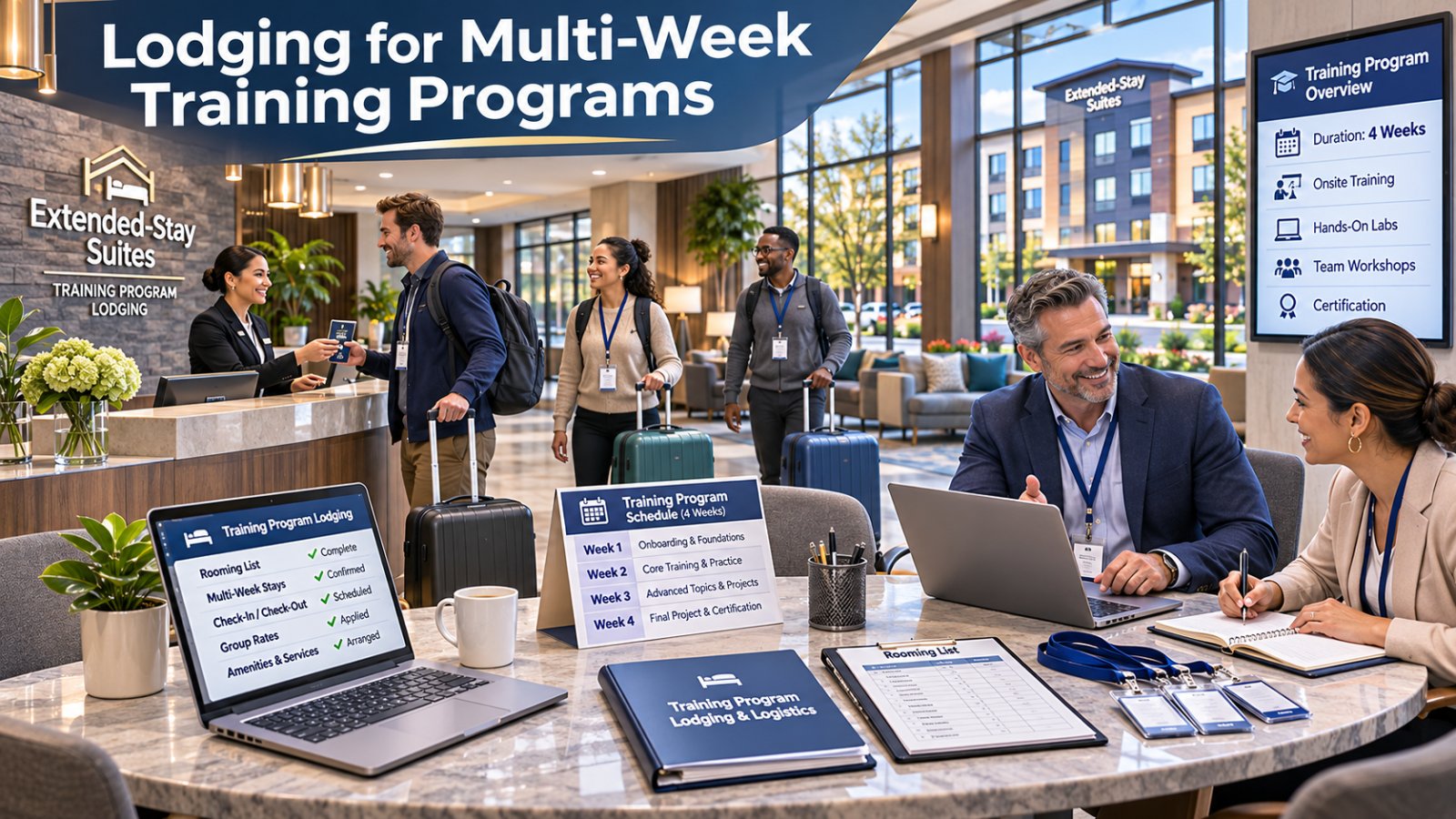
For lodging for multi-week training programs, the right choice usually comes down to cost per student-week and how much supervision and flexibility you need. Extended stay hotels tend to win when cohorts run three weeks or longer because the weekly rate and the in-room kitchen cut both nightly cost and meal spend. Standard hotels win on supervision and predictability for shorter stays, and shared rentals rarely pencil out once you account for liability, furnishing, and the management hours no one budgets for.
That is the short answer. The longer answer matters because the wrong call on a 50-person cohort compounds every single week. Below is how an operator who has sat on both the hotel and procurement sides of this actually compares the three.
How to compare lodging for multi-week training programs
Nightly rate is the wrong number to anchor on. For a cohort that stays weeks at a time, the figure that governs your budget is cost per student-week, and it is driven by four things most planners underweight: the rate structure, meal access, supervision load, and transportation.
- Cost per student-week. A nightly rate that looks fine for a two-night meeting can be brutal across 21 or 28 nights. Extended stay properties price on weekly and monthly tiers, and those tiers drop meaningfully the longer the stay runs. If your contract still bills a flat nightly rate for a month-long cohort, you are leaving money on the table.
- Kitchen access. No kitchen means three restaurant meals a day per student, every day, for the length of the program. A full or partial kitchen converts most of that spend into a grocery line and gives students who are training hard a way to eat on their own schedule.
- Supervision and student services. If your program has duty-of-care obligations, a single property with a front desk, a known point of contact, and everyone under one roof is far easier to manage than students scattered across rental addresses.
- Flexibility. Cohort counts move. Start dates slip. You want a lodging structure that absorbs a late add or a drop without triggering a penalty you did not see coming.
- Transportation. A property two miles from the training site with no shuttle quietly becomes a daily rideshare bill or a van rental you did not plan for. Walking distance or a shuttle changes the real cost more than the room rate does.
The three options, side by side
Here is how the formats generally stack up for a multi-week cohort. Treat the cost column as direction, not dollars, because rates move by market and season.
| Factor | Standard hotel | Extended stay hotel | Shared rental |
|---|---|---|---|
| Cost per student-week | Higher; priced nightly | Lower; weekly/monthly tiers | Variable; hidden costs inflate it |
| Kitchen access | Rare | Standard (full or partial) | Usually yes |
| Supervision / point of contact | Strong (front desk, one roof) | Strong (front desk, one roof) | Weak (no onsite staff) |
| Flexibility on counts | Room-block terms apply | Room-block terms apply | Rigid lease terms |
| Transportation | Depends on location | Depends on location | Often scattered sites |
| Contract / liability risk | Known clauses | Known clauses | On you to manage |
Where standard hotels fit
Standard hotels make sense for short programs, for cohorts that need daily housekeeping and meeting space in the same building, and for markets where extended stay supply is thin. The tradeoff is cost: without a weekly rate structure and without kitchens, your lodging and meal spend both run higher over a long cohort.
Where extended stay wins
For most training programs running three weeks or longer, extended stay is the default to beat. The weekly and monthly rate tiers lower cost per student-week, the in-room kitchen cuts meal spend, and you still get a front desk and a single managed location for supervision. This is the core of what we handle on Technical Training Housing programs.
Where shared rentals usually fail the math
Shared rentals look cheap on the listing price and then quietly cost more. You absorb furnishing gaps, cleaning between cohorts, utility setup, liability with no onsite staff, and the hours someone on your team spends playing property manager. They also tend to scatter students across addresses, which breaks supervision and multiplies your transportation problem. For a short, small group in a market with no hotel supply they can work, but for a structured cohort they rarely beat a negotiated extended stay block.
The contract terms that quietly cost you
The format is only half the decision. The terms underneath it are where multi-week programs lose money, because training cohorts have a different risk profile than a two-night meeting.
- Attrition. This is the clause that bites training programs hardest. Attrition sets the percentage of your room block you are financially responsible for even if students do not show. Cohort counts shift right up to the start date, so you want attrition negotiated to reflect how training actually fills, not a boilerplate figure the hotel offers first.
- Cancellation and reduction windows. If a cohort gets delayed or resized, the dates by which you can cut rooms without penalty matter enormously. Negotiate rolling reduction rights, not a single cliff.
- Rate protection. For recurring cohorts, lock the rate across the series instead of renegotiating each time and exposing yourself to spikes in a tightening market.
- Taxes and fees. Long stays can change how certain lodging taxes apply in some jurisdictions. Do not assume. Confirm the rule for your specific market and length of stay. [VERIFY: applicable extended-stay lodging tax treatment by market]
- Incidentals and folio reconciliation. Decide up front what the master account covers versus what students pay, or you will spend the program reconciling hundreds of folios against policy line by line.
The smarter play on all of this is to negotiate the block and the clauses together, before you sign, with someone who knows which numbers the hotel will actually move. That is the job we do across Technical Training Housing and, for larger field deployments, Construction Workforce Housing.
A pre-sourcing checklist for your next cohort
- Confirmed training location and distance to lodging options
- Students per cohort and realistic high/low range
- Cohort length in weeks and whether it recurs
- Next cohort start date and known risk of slippage
- Kitchen requirement (full, partial, or none)
- Supervision and duty-of-care requirements
- Transportation plan: walkable, shuttle, or vehicles
- Budget expressed as cost per student-week, not nightly rate
Bring those to the table before you talk to a single property and you negotiate from strength. Bring nothing and the hotel sets the terms.
Frequently asked questions
What is the best lodging option for a multi-week training program?
For cohorts running three weeks or longer, extended stay hotels are usually the best option because weekly and monthly rate tiers lower the cost per student-week, in-room kitchens cut meal spend, and a single property keeps students under one roof for supervision. Standard hotels fit shorter programs or markets with thin extended stay supply, and shared rentals rarely beat a negotiated block once hidden costs are counted.
How do you calculate cost per student-week for training housing?
Start with the negotiated weekly or nightly room rate, then add estimated meal spend (much lower with a kitchen), transportation to the training site, and any taxes and fees that apply to long stays in that market. Dividing the full weekly total by the number of students gives a truer comparison than nightly rate alone.
What is attrition in a hotel room block and why does it matter for training?
Attrition is the percentage of your contracted room block you must pay for even if those rooms go unused. It matters most for training because cohort counts shift up to the start date, so an attrition figure negotiated to match how your program actually fills protects you from paying for empty rooms.
How far in advance should training room blocks be booked?
Secure room blocks well ahead of the start date to lock rate and availability, especially for spring cohorts and tight markets. Earlier sourcing gives you leverage on attrition, cancellation, and reduction terms before the hotel's inventory tightens.