
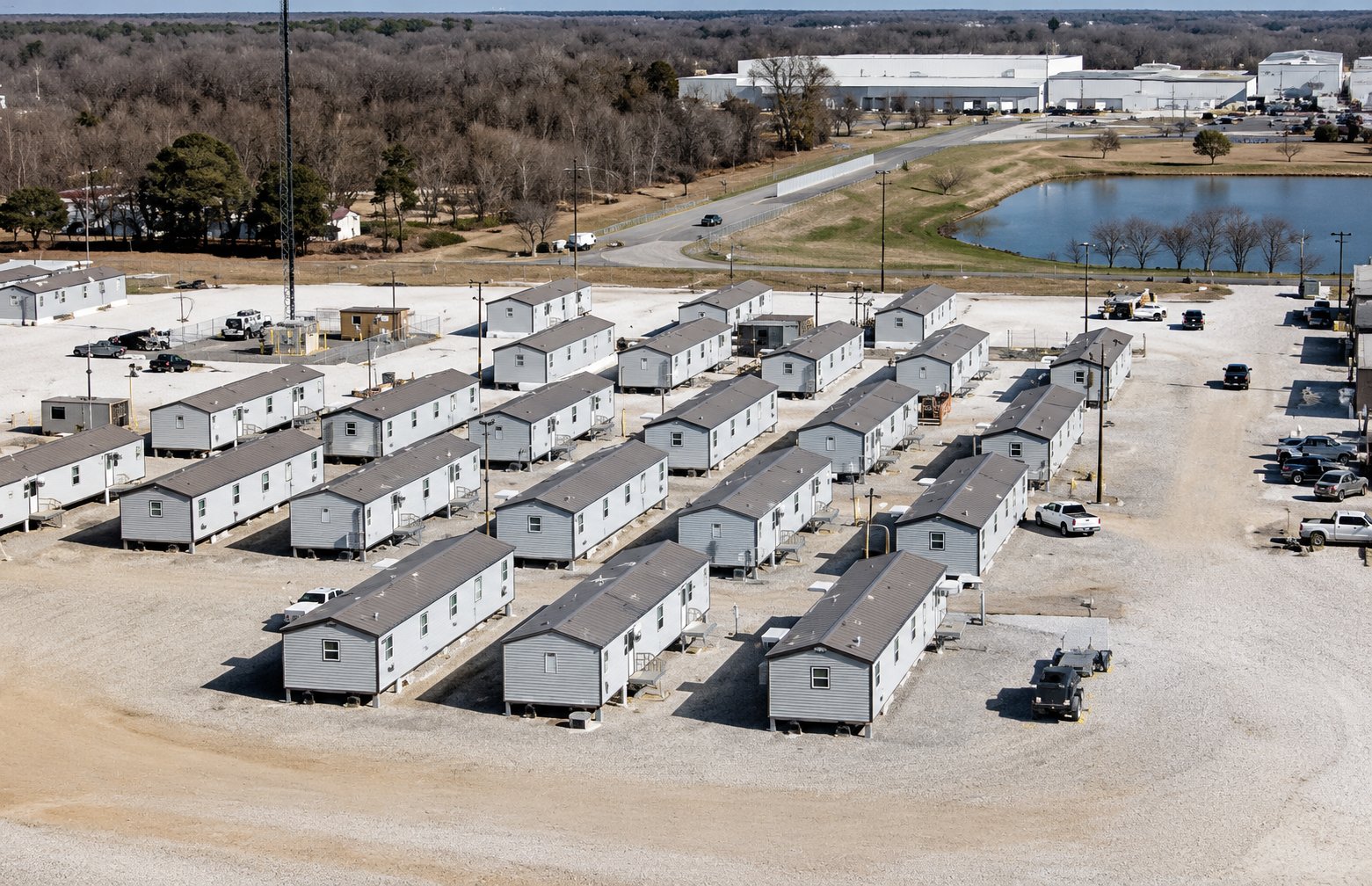
Choose your workforce housing model on three variables: how long the crew stays, how much hotel supply exists near the site, and how much control you need over cost and conditions. Hotel blocks win for shorter deployments in markets with real supply; purpose-built man camps win on remote sites with hundreds of workers and no rooms for miles; RV parks fill the gap where crews bring their own units or supply is thin but not zero. Most large projects end up using a blend, and the costliest mistake is treating the decision as permanent instead of phased.
How the three models actually differ
These are not interchangeable options that happen to house people. Each carries a different cost structure, a different risk profile, and a different set of contract terms that decide whether you come out ahead or bleed money on penalties and overruns.
Hotel blocks
You negotiate a set number of rooms at a negotiated rate under a room block agreement that specifies pickup, attrition, and cancellation terms. The upside is speed and simplicity: the rooms already exist, they are staffed, cleaned, and insured, and your crew gets real beds and predictable service on day one. The downside is that you are renting someone else's inventory in a market that may tighten under you.
The clause that hurts people is attrition. If you block 40 rooms and your crew shrinks to 30, you can owe for a percentage of the unused rooms unless the contract lets you reduce the block on a schedule. The second trap is a rate that floats or expires mid-project, so a market event or a busy convention week spikes your cost with no protection. Both are negotiable up front and expensive to fix after signing.
Man camps (purpose-built workforce lodges)
These are modular or built-to-purpose facilities: dorm-style or private sleeping units, on-site dining, laundry, and sometimes recreation, put up specifically to house a crew where no hotels exist. For a several-hundred-person, multi-year build in a remote market, this is often the only model that works at scale. Cost per bed can be efficient once occupancy is high and the facility is amortized across a long stay.
The hidden costs are the ones that never appear in the per-bed quote: mobilization and demobilization of the units, catering contracts with minimums, utility and water and sewer buildout, security, and the ramp period when the camp sits half-empty but you still pay fixed operating cost. If your headcount is uncertain or the project could slip, a fixed-capacity camp turns your schedule risk into carrying cost.
RV parks and pad rentals
This works when workers bring their own RVs or when a company stages units and rents pads with hookups. It is cheaper per pad than a hotel room and gives workers autonomy. But it only functions where a park with capacity sits near the site, and it pushes real burden onto the worker and onto you: no housekeeping, no front desk, weather exposure, and a much thinner safety and compliance envelope. In a genuinely remote build there often is no park to rent, which is exactly why man camps exist.
The decision framework
Run the choice through these questions in order. The answers usually point clearly to one model or a blend.
- How long is the stay? Nights to a couple of weeks favors hotel blocks. Months favors extended stay or purpose-built lodging where the nightly economics improve with length.
- What is the local supply? Pull a real read on hotel inventory within a reasonable commute. If there are enough beds and the market is not overheated, a block is the fastest path. If there are almost none, you are in man-camp territory.
- How big and how certain is the crew? Large and firm headcount justifies fixed-capacity lodging. Small or uncertain headcount favors flexible room blocks you can scale down.
- How much control do you need? Meal service, security, drug-and-alcohol policy, and site rules are easier to enforce in a controlled camp than across scattered hotel rooms or RV pads.
- What is the demobilization plan? Whatever you stand up, you have to take down. Camps carry demob cost; blocks and extended-stay simply end. Price the exit before you sign the entry.
Where extended stay changes the math
The model people forget is the extended-stay hotel. For crews of moderate size on multi-week or multi-month deployments in markets that have some supply, extended-stay properties combine the service and safety of a hotel with kitchenettes, weekly rates, and stay-length pricing that beats a standard nightly block. You avoid the capital and demob burden of a camp and the exposure of an RV park, and you still get housekeeping, front-desk coverage, and a real insurance and compliance posture. On the right project this is the cleanest middle path, and it is worth pricing before you assume a camp is your only option. See how Sagen structures this in Extended Stay and workforce housing.
Why AI data center builds break the usual playbook
Data center construction has a specific pattern: fast timelines, large crews, and sites chosen for power and land rather than hotel supply. That combination lands hundreds of workers in markets that cannot absorb them, and it does so on short notice. A pure hotel-block approach runs out of rooms; a pure camp approach is slow to stand up if the schedule moves. These projects almost always need a phased blend, hotel and extended-stay inventory for early and specialty crews plus purpose-built capacity for the peak. Sagen built a dedicated program for AI data center workforce housing precisely because this market punishes single-model thinking.
The most expensive mistake: choosing the model before you cost the exit
Buyers focus on the per-bed or per-room rate and skip the contract mechanics that decide the real number. On hotel blocks that means attrition and cancellation. On camps it means catering minimums, ramp cost, and demobilization. On RV parks it means the compliance and duty-of-care gaps you inherit. The smarter play is to model total cost across the full project life, negotiate the exit terms with the same rigor as the entry, and keep the flexibility to shift models as headcount and schedule move. That is a management function, not a one-time sourcing event, which is why many organizations hand the whole program to one partner under strategic hotel program management.
Frequently asked questions
Which is cheaper: a man camp or a hotel block?
It depends on crew size and stay length. For large crews on long, remote deployments, a man camp's per-bed cost can beat hotels once occupancy is high, but you also carry mobilization, catering minimums, and demobilization. For smaller crews, shorter stays, or markets with real supply, negotiated hotel or extended-stay rates usually win because there is no capital or demob burden. The honest answer requires modeling total cost across the whole project, not comparing a single nightly figure.
When does an RV park make sense for workforce housing?
RV pads work when workers already own units or when you stage units yourself, and only where a park with capacity sits within a reasonable commute of the site. It is cheaper per pad than a hotel but shifts housekeeping, safety, and weather exposure onto the worker and thins your duty-of-care coverage. In genuinely remote builds there is often no park to rent, which is why purpose-built lodging exists.
What contract terms matter most for a hotel room block?
Attrition and cancellation clauses matter most. Attrition sets how many blocked rooms you must pay for even if your crew shrinks, and a scheduled reduction right protects you when headcount drops. Cancellation terms govern what you owe if the project slips or ends early. Rate protection keeps a market spike or a busy week from raising your cost mid-project. Negotiate all three up front, because they are expensive or impossible to fix after signing.
How do you house a large crew in a market with no hotels?
You blend models by project phase: use available hotel and extended-stay inventory for early and specialty crews, then add purpose-built or modular capacity for the peak headcount. The key is starting the sourcing early, negotiating exit and demobilization terms before you commit, and keeping flexibility to scale as the schedule and headcount move. This is the standard pattern on remote infrastructure and data center builds.
Should workforce housing be managed in-house or outsourced?
Outsourcing to a specialist usually pays off when the project spans multiple markets, involves contract risk you are not equipped to negotiate, or requires blending several housing models over time. A partner who sources, negotiates, and manages the program handles attrition, reconciliation, and demobilization as one continuous function rather than a series of one-off deals, which is where in-house teams lose money on penalties and overruns.