
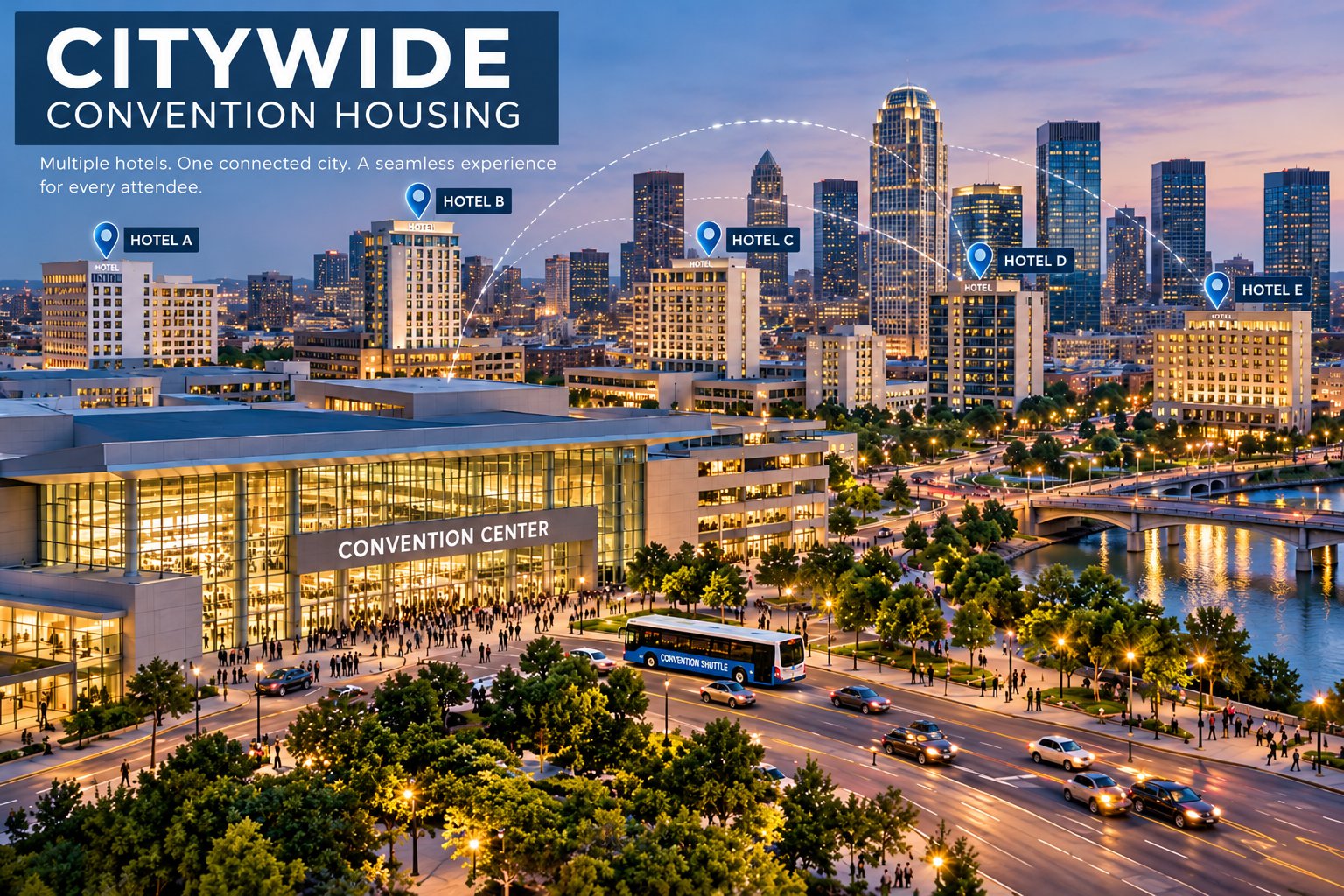
A citywide convention is an event large enough that no single property can house all attendees, so the host organization books a convention center plus a package of hotels across the market. Citywide convention housing is the system that ties those hotels together under coordinated dates, rates, and contract terms, usually with help from the local convention and visitors bureau (CVB). The planner's job is not to find one hotel. It is to manage a portfolio of room blocks, plus the convention center and affiliated event spaces, that all have to perform on the same nights.
If you plan association or corporate meetings, the moment your attendee count outgrows the largest hotel in a market, you stop being a single-hotel buyer and become a lodging program manager. The mechanics change, the risk changes, and the contract terms you did not negotiate start to matter.
What makes a convention "citywide"
There is no universal attendee threshold. A convention is treated as citywide when the room demand on peak nights exceeds what the headquarters hotel can hold, forcing the program into multiple properties. In practice, that usually means the event is booking the convention center for general sessions and exhibits, then distributing sleeping rooms across a cluster of nearby hotels.
The structure typically looks like this:
- Convention center: the general sessions, exhibit hall, and large breakouts happen here. It is booked separately from sleeping rooms, often directly with the center or through the CVB.
- Headquarters hotel: the primary property, usually closest to the center or largest in the block. It hosts VIPs, board meetings, staff offices, and the biggest share of rooms.
- Overflow hotels: the supporting properties that absorb the rest of the demand. These range from full-service to select-service and sit at different rates and walking distances.
- Affiliated event venues: the offsite spaces a large event leans on, such as arenas for a general session that outgrows the hall, museums or restaurants for an opening reception, and private venues for a board dinner or sponsor party. Each one is its own contract with its own deposit, food and beverage minimum, and cancellation terms.
Each hotel in the package signs its own contract with its own block, rate, attrition clause, and cutoff date. The convention center and every affiliated venue sign their own agreements as well. That is the part planners underestimate. You are not negotiating one deal. You are negotiating and then managing many deals that have to behave as one program.
How citywide convention housing is actually coordinated
Three parties touch a citywide program, and knowing who owns what prevents the gaps where money leaks.
The CVB
The convention and visitors bureau is the market's front door. The CVB helps secure the convention center dates, issues a coordinated hotel lead to properties across the city, and often sets a "room block commitment" the event agrees to in exchange for center space or incentives. The CVB is genuinely useful for assembling the initial package. What the CVB does not do is manage your contract risk, reconcile your folios, or sit on your side of the table when a hotel pushes an aggressive attrition clause. The CVB serves the destination. You still need someone serving you.
The hotels
Each property controls its own inventory and terms. A headquarters hotel will often ask for a larger block and more favorable concessions because it carries the event's weight. Overflow hotels compete for the overflow demand and are frequently where the best negotiating leverage sits, because they want the business and are more flexible on attrition, cutoff, and comp ratios.
The housing manager
Someone has to run the reservation layer: a central way for attendees to book into the right hotels, with sub-blocks tracked, pickup monitored, and inventory shifted between properties as demand reveals itself. This is where a dedicated partner earns its place, because pickup never matches the original plan and the program has to be adjusted in real time to avoid attrition penalties.
Sagen Global works on the buyer's side of all of it. We source the hotel package and negotiate each contract, and we also negotiate the convention center space and affiliated events, from offsite parties to arena buyouts, managing the block day to day through group accommodations management, so the planner has one partner instead of a stack of separate venue and hotel relationships.
Why the type of event changes the whole negotiation
Before you size a block or price a venue, you have to understand what kind of event you are actually producing, because the room commitment is only half of what a supplier is evaluating. A trade show with elaborate exhibit booths and heavy production needs requires significantly more move-in and move-out time in the exhibit hall. Those extra setup and teardown days drive the general contractor budget, the production partners, rigging and electrical, and all the associated labor, and they also create a separate need you have to plan for: discounted staff and crew housing that should be pre-negotiated alongside the attendee block, not treated as an afterthought.
That event profile also directly shapes how willing the convention center or hotels are to give you dates and favorable rates. The supplier's goal is to fill space and optimize occupancy across the whole building and the whole city. If a convention occupies the exhibit hall and meeting space for multiple days but does not bring a commensurate block of guest rooms and attendees into the market, the supplier is losing the revenue it could otherwise capture from a group that fills both. The predictable response is one of two things: the center or hotels inflate pricing to make up the difference for what they could have booked, or they pass on the opportunity altogether and hold the dates for a denser piece of business.
The smarter play is to walk in understanding your own ratio of occupied space to room nights and attendees, and to lead with the total value of the program, including crew and staff room nights, so the supplier sees a full-building win rather than a hall rental with thin lodging behind it. That framing is what keeps your dates available and your rates honest.
Peak night, attrition, and where planners get exposed
The single most important number in a citywide program is peak night: the night with the most rooms occupied across all hotels. Peak night drives your total block, your attrition exposure, and the center's room commitment. Build the block around peak night and you overcommit on the shoulder nights. Build it too lean and you run out of rooms at your contracted rate and push attendees into walk-up pricing.
Here is how the exposure stacks up across a multi-hotel block:
- Attrition clause: each hotel sets a percentage of the block you must fill. Miss it and you pay for unused rooms. Across a dozen hotels, uncoordinated attrition is where citywide budgets quietly bleed.
- Cutoff date: the date unsold rooms release back to the hotel. Set too early and attendees who book late pay rack rates. Set too late and you carry attrition risk longer.
- Cancellation and reduction clauses: the right to reduce the block without penalty, and the sliding scale of damages if you cancel. These are negotiable and are the terms planners most often sign without reading.
- Sub-block shifting: whether you can move rooms between hotels as pickup develops. Without this, a strong overflow hotel's unused rooms count against you while attendees sit on a waitlist elsewhere.
- Venue and center clauses: the convention center and affiliated venues carry their own food and beverage minimums, deposit schedules, and cancellation penalties. A reception that underperforms its F&B minimum is the same unused-commitment problem as room attrition, in a different contract.
The smarter play is to negotiate attrition and cutoff as a coordinated program, not property by property, and to build in the right to reallocate rooms before penalties trigger. That requires watching pickup across every hotel every week, which is exactly the management layer most planners do not have time to run.
A planner's citywide housing checklist
- Define the event profile first: how much setup and teardown your exhibits and production require, and how that drives the general contractor, production partners, and labor budget.
- Pre-negotiate discounted staff and crew housing alongside the attendee block, not after it.
- Know your ratio of occupied space to room nights and attendees before you approach a supplier, since a thin room block against heavy space use invites inflated pricing or a declined booking.
- Define peak night demand before you size any block.
- Secure the right convention center and affiliated event space, including offsite venues and arenas, and lock their dates to the room program.
- Confirm the convention center's room commitment and how it is measured.
- Negotiate attrition, cutoff, and cancellation at each hotel, then align them across the package.
- Review F&B minimums, deposit schedules, and cancellation terms on the center and every affiliated venue.
- Secure the right to shift sub-blocks between hotels as pickup develops.
- Set one central housing process so attendees book into the correct property.
- Track weekly pickup and adjust the block before attrition triggers.
- Reconcile every folio and venue invoice against the contracted rate and concessions after the event.
Large events contract years out, and the strongest hotel packages and center dates go first. The groups that lock favorable terms are the ones in the market early with someone who knows which clauses to push.
Frequently asked questions
What is the difference between a headquarters hotel and an overflow hotel?
The headquarters hotel is the primary property for a citywide convention. It usually sits closest to the convention center, carries the largest room block, and hosts VIPs, staff offices, and board functions. Overflow hotels are the supporting properties that absorb the rest of the attendee demand at varying rates and walking distances. Both sign separate contracts, and overflow hotels often offer more negotiating flexibility because they are competing for the business.
Who coordinates hotels and venues for a citywide convention?
The convention and visitors bureau helps assemble the initial hotel package and secure convention center dates, but it represents the destination, not the planner. The individual hotels and venues control their own inventory and contract terms. A housing partner or consultancy coordinates the program on the buyer's side, negotiating each hotel contract along with the convention center space and affiliated events, running the central reservation process, and managing pickup and attrition across all properties.
Why does the type of event affect convention center pricing and availability?
Suppliers price and award dates based on how well an event fills both their space and the surrounding hotels. An event with elaborate exhibits and heavy production needs ties up the hall for extra setup and teardown days, which raises your general contractor and labor costs and requires pre-negotiated crew and staff housing. If that event occupies the building without bringing a commensurate block of guest rooms and attendees into the city, the supplier may inflate pricing to recover the business it could have booked, or decline the dates entirely. Leading with the total value of the program, including crew room nights, keeps dates available and rates in line.
What is peak night in convention housing?
Peak night is the single night during a convention when the most rooms are occupied across all contracted hotels. It drives the total room block size, the attrition exposure, and often the convention center's room commitment. Sizing the block correctly around peak night without overcommitting on shoulder nights is one of the most important parts of citywide housing.
How do you avoid attrition penalties on a multi-hotel block?
Negotiate attrition, cutoff dates, and reduction rights as a coordinated program rather than one hotel at a time, build in the right to shift sub-blocks between properties as demand develops, and track pickup weekly so the block can be adjusted before penalties trigger. Watch the same risk on affiliated venues, where food and beverage minimums work much like room attrition. Uncoordinated commitments across many contracts are where citywide budgets most often overspend.
How far in advance should citywide conventions book hotels and venues?
Large citywide events typically contract several years out because convention center dates, affiliated event space, and the strongest hotel packages are claimed early. The specific lead time depends on the market and the size of the event. Being in the market early with someone who knows the terms to negotiate is what secures the best rates and concessions.