
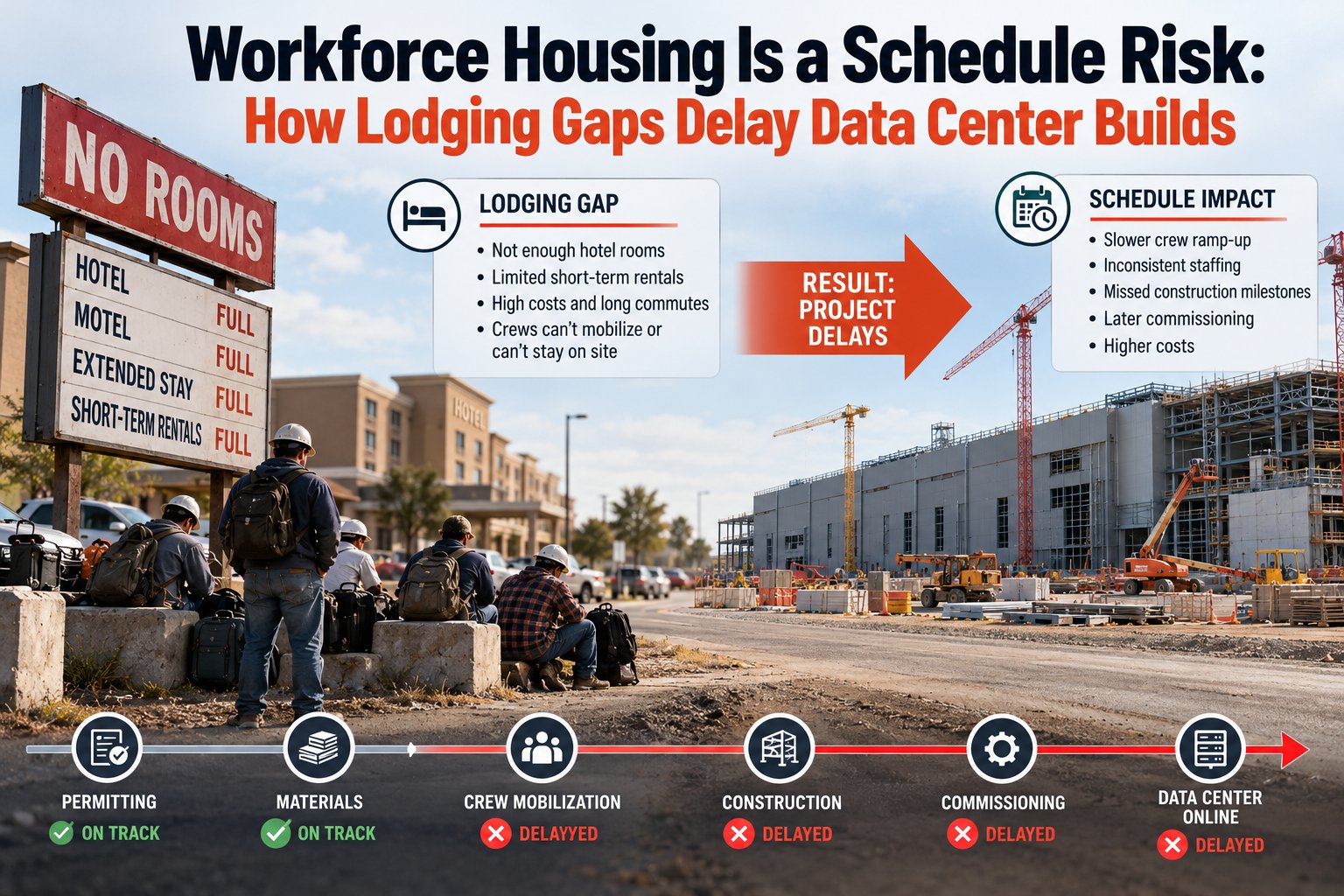
On a remote data center build, a lodging gap does not stay a lodging problem. It converts directly into schedule slip. When a project cannot cover the beds its headcount requires, the shortfall shows up as late mobilization, no-shows on the first shift, and skilled crews quitting mid-deployment because the housing is an hour away or priced beyond their per diem. The fix is to treat lodging as a line item on the schedule, sourced and contracted in parallel with the ramp, not scrambled after crews are already assigned.
Why a lodging gap becomes a schedule delay
Your critical path assumes a certain number of trades on site on a certain date. That assumption quietly depends on those people having somewhere to sleep within a reasonable commute. When the housing is not there, the schedule does not forgive you. It reacts in three predictable ways.
- Late mobilization. Crews travel in from other regions. If rooms are not confirmed, people do not board flights or drive in. A one-week housing delay on a specialty trade can push every dependent activity by the same week or more.
- No-shows and partial crews. When lodging is marginal, far away, or over budget, a share of the assigned crew simply does not arrive. The foreman shows up with fewer hands than planned and the day's production falls short.
- Turnover mid-project. A tradesperson spending ninety minutes each way, sharing a room they did not expect to share, or covering the gap between a negotiated rate and a market rate out of pocket, leaves. Replacing and re-onboarding a skilled worker costs you days, not hours.
None of these appear on a lodging invoice. They appear as slippage in the field, which is why they get blamed on weather, inspections, or labor supply when the root cause was a housing plan that trailed the schedule instead of leading it.
The market dynamics that make remote builds hard to cover
Data centers get built where power and land are available, which is frequently a market with thin hotel supply. That creates specific, repeatable problems.
You become your own compression event. A large build drops a heavy volume of room-nights into a town that may have only a handful of properties. Availability tightens, rates climb, and every other crew in the market, including other contractors on your own site, competes for the same beds. Once a property sees that demand materialize, its willingness to negotiate drops, because it no longer needs your volume to fill rooms.
Supply that was never designed for long stays. Many remote markets have limited true extended stay product with kitchenettes and laundry. Transient hotels can house a long deployment, but they price for nightly turnover and do not offer the per-week economics a long stay should earn. Knowing which properties will actually convert to extended stay terms, and which will not, is an inside read most procurement teams do not have time to develop.
The wider demand calendar you do not control. If mobilization lands on top of a regional event or seasonal peak, you compound your own compression with someone else's. Sourcing early is partly about getting ahead of your own demand and partly about getting ahead of a calendar you cannot move.
The contract terms that quietly carry the risk
A lodging program is only as good as its contract. The clauses below are where schedule and budget risk hide, and where someone who has sat on both sides of the table earns their keep.
- Attrition. A block commits you to a volume of room-nights. If the crew ramps slower than planned, or a scope change trims headcount, you can owe for rooms you never used. On a build where headcount flexes constantly, a rigid attrition clause is a standing liability. The smarter play is a structure with realistic adjustment windows and review points tied to the ramp.
- Cancellation. Projects pause. If your cancellation terms do not account for the reality of construction schedules, a stand-down becomes a penalty. Negotiate the exit before you need it, and tie release provisions to project milestones rather than fixed calendar dates.
- Rate protection. In a compressing market, a rate that floats or resets can climb mid-project. Lock the rate and the duration so your budget does not move under you, and watch for parking charges, fees, and other add-ons that reappear outside the negotiated rate.
- Length-of-stay economics. Nightly transient rates are the wrong instrument for a multi-month deployment. Extended stay terms should reflect the stay, not the night. This is exactly where per diem thinking leaves money on the table versus a negotiated program rate.
For how these terms are sourced and managed day to day, see our solution for extended stay and workforce housing.
Per diem versus a negotiated program
Here is the practical difference on a build.
- Per diem only: each worker books their own room at whatever the market offers. In a compressed remote market that rate can exceed the per diem, so the worker pays the gap or does not come. You have no visibility, no volume leverage, and no control over where crews actually stay.
- Negotiated program: one partner commits volume, locks rates and terms, places crews in consistent extended stay housing within commute, and manages the program from first request to final folio. The schedule gets predictability and the budget gets protection.
For data center and large infrastructure work specifically, Sagen runs this as a dedicated program. See AI data center workforce housing for how the sourcing, contracting, and management fit together, and note that many programs are managed at no direct cost to the client.
A pre-mobilization lodging checklist
Run this before crews are assigned, not after. If you cannot answer the top items yet, lodging is behind your schedule.
- Headcount curve by week, including ramp up and ramp down, not just a peak number.
- Maximum acceptable commute time from lodging to site.
- Confirmed room-night demand mapped against known supply within that commute.
- Extended stay product requirements: kitchenette, laundry, parking for crew vehicles.
- Negotiated rate and duration locked, with rate protection in writing.
- Attrition and cancellation terms reviewed against your real schedule risk.
- A single point of accountability for sourcing, contracts, and day-to-day management.
- A reconciliation process so hundreds of folios can be checked against policy without burying your staff.
Frequently asked questions
What is data center workforce housing?
Data center workforce housing is the lodging program that covers the construction and commissioning crews building a data center, typically extended stay accommodations near a remote site, contracted for multi-week or multi-month deployments at negotiated rates rather than nightly transient pricing.
How does a lodging shortage delay a construction schedule?
When beds are not confirmed near the site, crews mobilize late, a share of assigned workers do not show, and turnover rises as people quit over long commutes or out-of-pocket rate gaps. Each of those lands on the critical path as a day you do not get back, even though it never appears on a lodging invoice.
When should we start sourcing lodging for a remote build?
As early as you have a headcount curve and a site location. Remote markets have thin supply, and a large build becomes its own compression event, so sourcing and contracting should run in parallel with the ramp plan, not after crews are assigned.
Is it cheaper to let workers book their own rooms on per diem?
Usually not on a remote build. In a compressed market the market rate can exceed the per diem, which pushes the gap onto the worker or causes no-shows, and you lose volume leverage and visibility. A negotiated program with locked rates and terms typically protects both the budget and the schedule.
What does Sagen Global do for data center lodging?
Sagen sources, negotiates, contracts, and manages extended stay workforce housing for data center and large infrastructure builds, handling attrition, cancellation, and rate protection terms and the day-to-day program through final folio. Many programs are managed at no direct cost to the client.